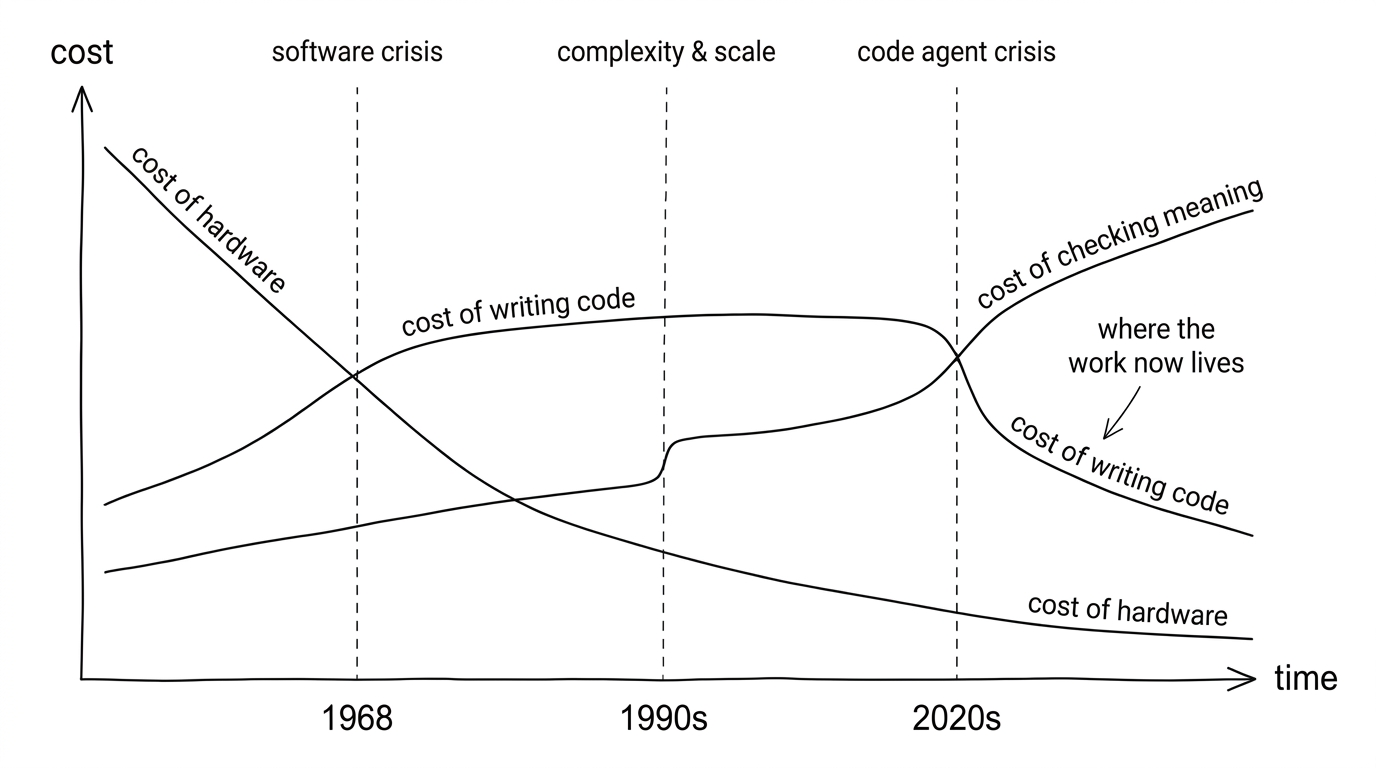
A line chart of three costs over time. The 'cost of hardware' curve starts highest on the left and descends across all three eras. The 'cost of writing code' curve starts moderate, rises through the 1960s to peak at the 1968 software crisis marker (where it overtakes the hardware curve), plateaus through the 1990s, then drops at the 2020s marker as agents take over writing. The 'cost of checking meaning' curve emerges sharply at the 2020s marker, rising to become the highest cost on the right. Three vertical dashed markers label '1968 software crisis', '1990s complexity & scale', '2020s code agent crisis'. An annotation 'where the work now lives' points to the widening gap between checking-meaning (high) and writing-code (low) on the right side.

The Code Agent Crisis

Software engineering has had two crises before. They had the same shape: something became cheap, and the work moved to whatever was still hard. We are in the middle of a third.
May 10, 2026 · 7 min · Yann Régis-Gianas
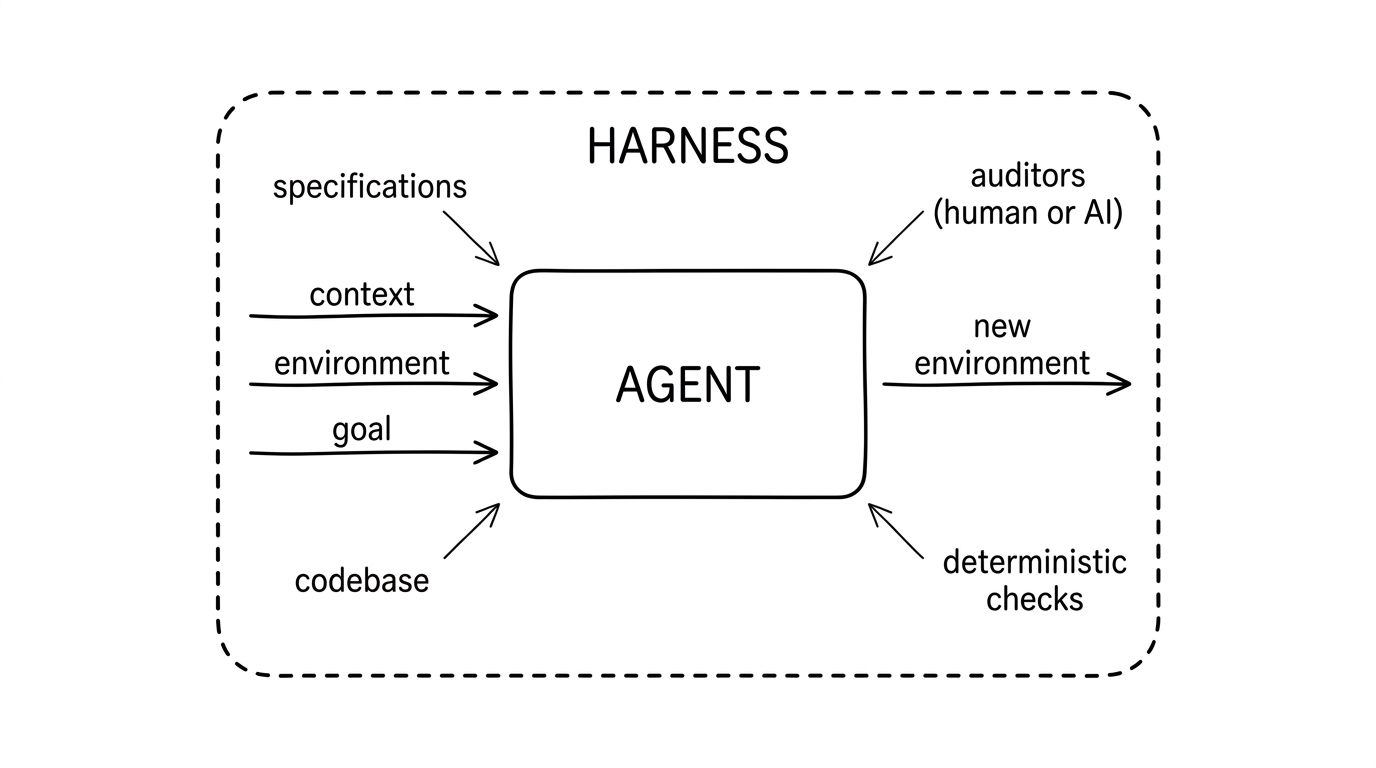
A diagram showing a solid rounded rectangle labelled AGENT inside a larger dashed rounded rectangle labelled HARNESS. Three arrows enter the agent from the left, labelled context, environment, goal. One arrow exits on the right, labelled new environment. All four harness components are positioned inside the dashed boundary, with thin arrows pointing inward to the agent: specifications (top-left interior), auditors human or AI (top-right interior), codebase (bottom-left interior), deterministic checks (bottom-right interior).

The harness, not the output

The agent is what it is. The system around it, the harness, is the durable engineering object. A small model, three disciplines, and a slogan: fix the harness, not the output.

May 22, 2026 · 10 min · Yann Régis-Gianas